
What tasks can an AI Call Agent handle on a call?
An AI Call Agent can answer FAQs, take and confirm appointments, qualify inbound leads and send them to the right salesperson, check order and account status, log basic complaints for follow-up, make outbound reminder calls, and collect customer feedback. With Televanta, what the agent can do depends entirely on the knowledge base and rules you set up, so a more complete setup leads to more calls handled without a human.
That last point matters more than people expect at first. Two businesses can run the exact same software and get very different results, simply because one spent time loading detailed answers, booking rules, and edge cases, while the other left the setup thin.
The AI isn't guessing at what your business does. It's working from what you've told it.
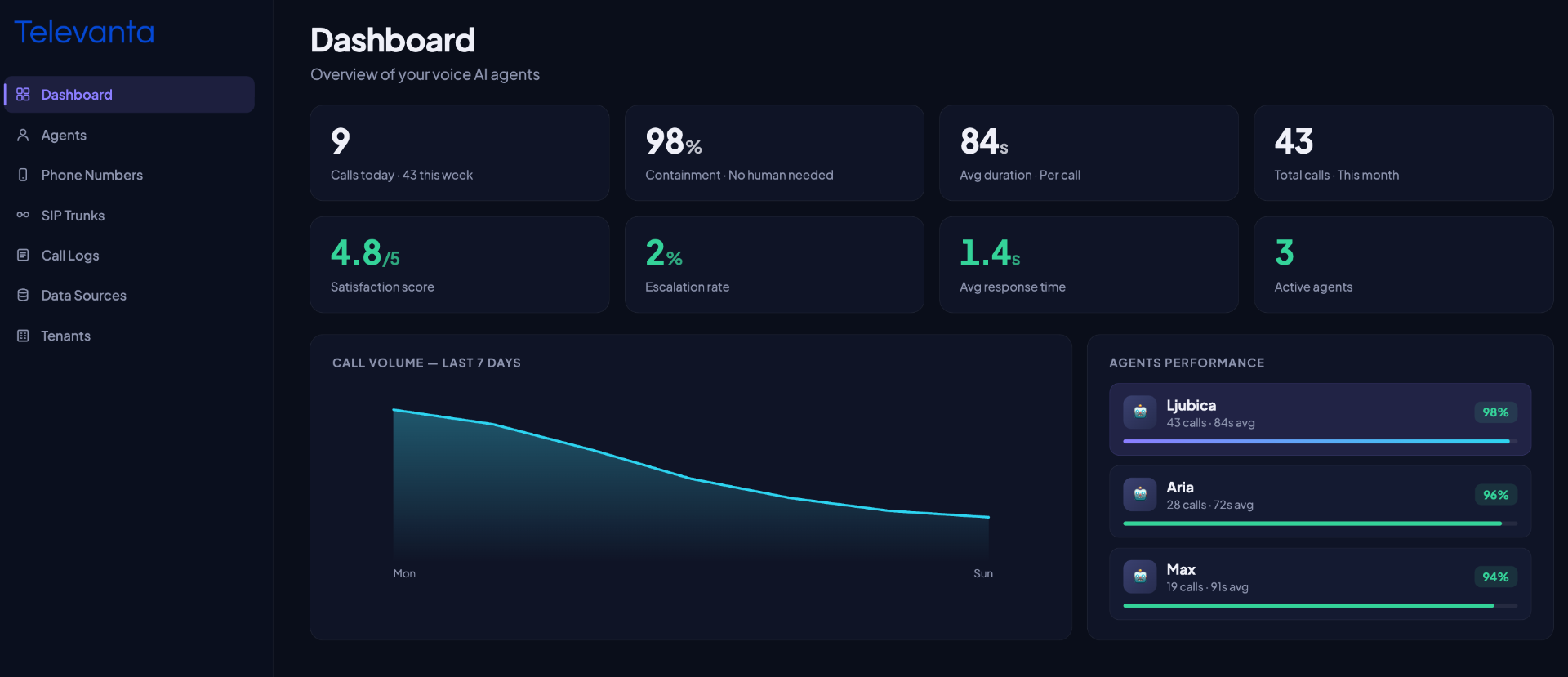
For example, take a car dealership. It uses Televanta to handle three separate jobs at once: booking test drives, sending service reminders, and answering parts availability questions.
All three run from one deployment with a single knowledge base, so the dealership isn't juggling three separate tools or three separate logins to manage them.
A property management company shows a slightly different shape of the same idea. Residents call one number, and the AI sorts each call into the right outcome: a maintenance request gets logged with the unit number and issue description, a rent payment question gets answered directly from the account system, and a lease renewal question either gets answered or passed to a human if it needs a real decision.
Every one of these gets written to the CRM automatically, so nobody on staff has to type up notes after the fact.
The range of tasks tends to grow over time as a business gets comfortable with the tool. Most start with the obvious use case, often booking or basic FAQs, and add more call types once they see how the AI handles the first ones.
A common early add is outbound reminder calls, since the same setup that answers inbound questions can also place calls to confirm an appointment or check in after a service visit.
It's worth being clear about where the edges are, too. An AI Call Agent isn't meant to replace every kind of conversation a business has over the phone.
Complex negotiations, emotionally difficult calls, and anything genuinely requiring a decision only a person can make still go to a human. The value comes from taking the repetitive, well-defined tasks off a team's plate so they have more time and attention for the calls that actually need a person's judgment.
There's also a question worth asking before adding a new task type: does this task have a clear, repeatable pattern? Booking an appointment follows the same basic shape every time — check availability, offer slots, confirm.
That makes it a good fit. A highly unusual one-off request, by contrast, is harder to automate well and usually isn't worth trying to force into the system.
Most businesses find it more effective to identify the five or six call types that make up the bulk of their volume and build those out thoroughly, rather than trying to cover every possible call type on day one.
See how AI Call Agent works in your stack.
A 30-minute walkthrough with a solutions engineer. No slides, just your use case.
Book a Demo →