
How does an AI voice agent log and report on calls?
Every call handled by Televanta's AI voice agent gets logged automatically in the operator portal, including the caller's number, how long the call lasted, a full word-for-word transcript, an AI-written summary, the intent it detected, a sentiment score, and whether the call was resolved or sent to a human. The whole log is searchable by date, phone number, or keyword, and the data can be exported or pushed straight into a CRM.
This solves a problem that's easy to overlook until it becomes a real headache: with a normal phone system, most of what happens on a call simply disappears the moment the receiver goes down. There's no record beyond whatever notes a person happened to jot down, if any.
Every call through Televanta leaves a full trail behind, without anyone having to remember to write it up.
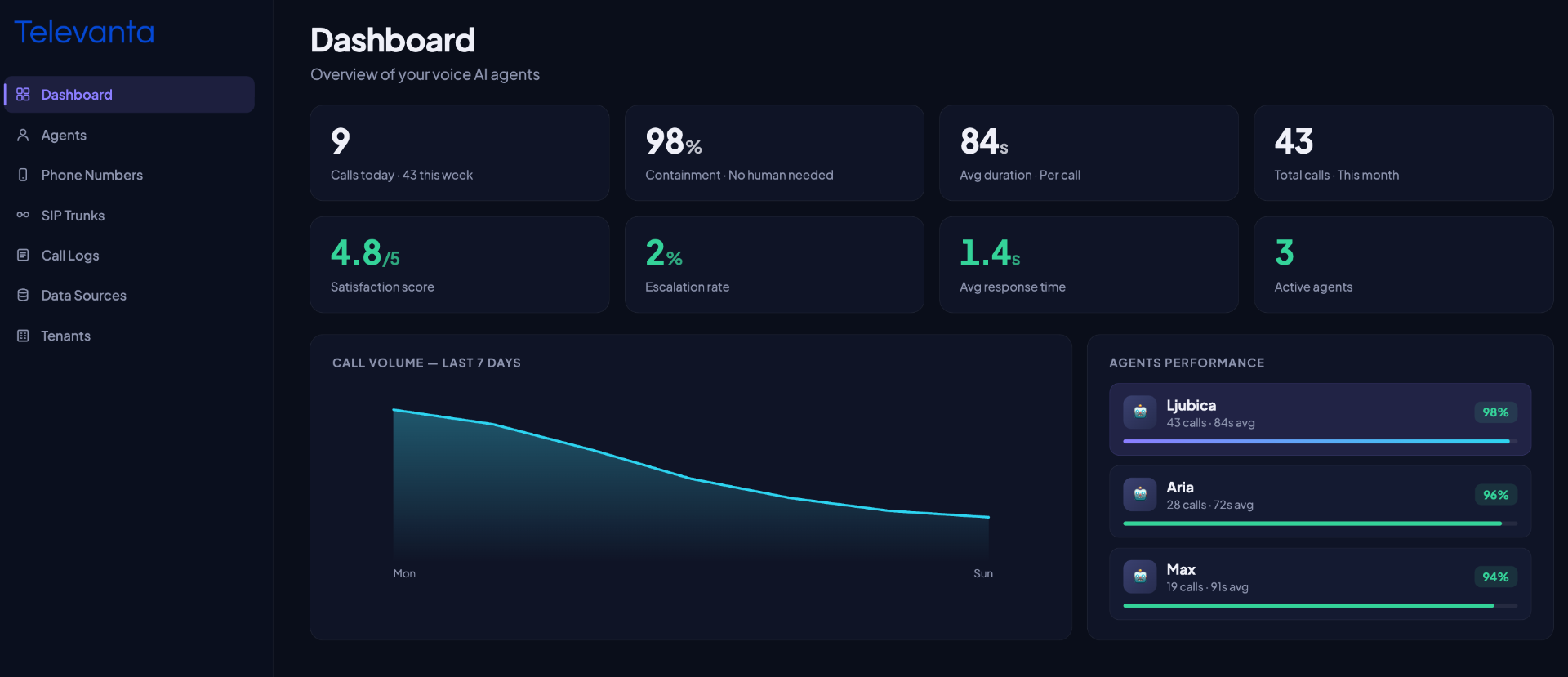
For example, a customer service manager gives a simple picture of how this gets used day to day. They search "billing dispute" in the call log and instantly see every call in the last 30 days where that topic came up, complete with sentiment scores and outcomes for each one.
That kind of search would take hours to do by listening back through recordings one at a time.
A contact center takes it a step further with quality reviews. Instead of picking calls at random to check on agent performance, supervisors filter specifically for low sentiment scores and review only the calls where a customer showed real frustration.
That turns quality assurance into something far more targeted, since the team is spending its limited review time on the calls most likely to reveal an actual problem, roughly five times more efficiently than random sampling would.
There's a training benefit hiding in here too, one that tends to get discovered rather than planned for. A manager reviewing a batch of calls can spot patterns fast: which questions keep coming up, where the AI seemed to struggle, which replies customers responded well to.
That feedback used to require sitting through recorded calls one by one. With a searchable, summarized log, it's closer to skimming a weekly report and knowing exactly where to focus next.
Data export matters for larger organizations especially, since call data rarely needs to live in just one place. A business running its own separate reporting system, or one that needs to hand call records to a compliance team on a set schedule, can pull the data out of Televanta on whatever cadence makes sense, rather than being stuck viewing everything only inside the operator portal.
This keeps Televanta compatible with however a company already tracks its own performance, instead of forcing a switch to a whole new reporting workflow just to get visibility into call activity.
Search speed matters more than people expect once a business has a few months of call history built up. Finding one specific call among tens of thousands would be nearly impossible without good search tools, and Televanta's call log is built to be filtered several ways at once, by date range, by outcome, by sentiment score, so a specific call or pattern can usually be tracked down in seconds rather than requiring someone to scroll through pages of results by hand.
See how AI Call Agent works in your stack.
A 30-minute walkthrough with a solutions engineer. No slides, just your use case.
Book a Demo →